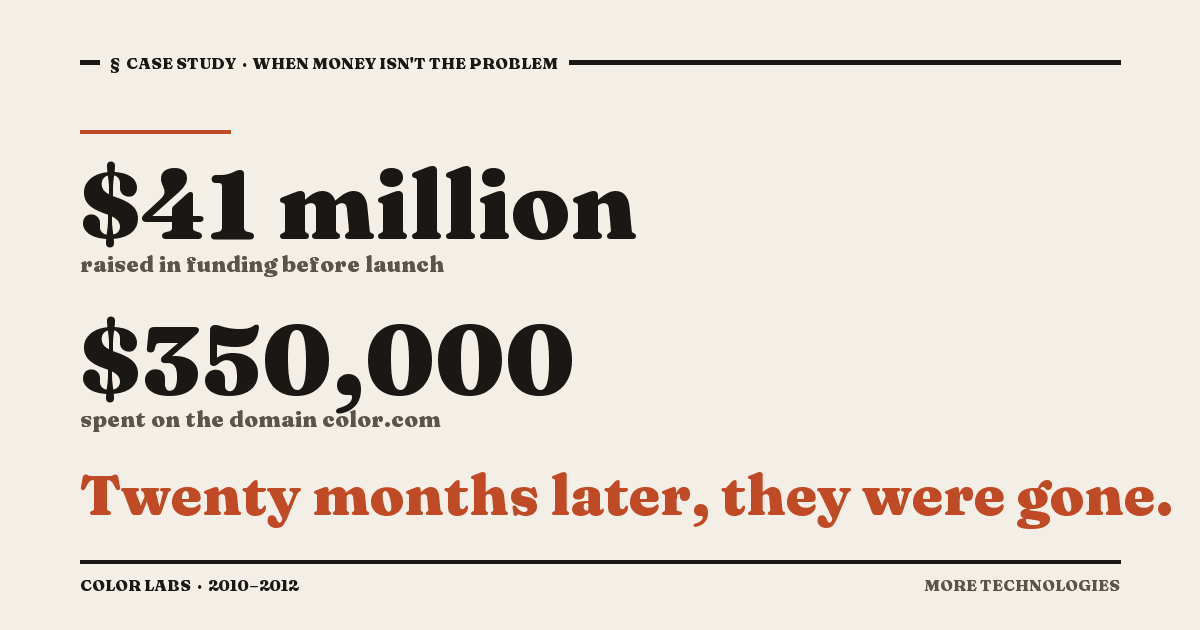
Color Labs raised $41 million in funding before they even launched. They spent $350,000 just to buy the domain name color.com. They built a beautiful photo-sharing app.
They forgot one thing. They never defined a clear customer or a reason for that customer to care. They skipped the hard questions. Twenty months later, Color Labs shut down. $41 million vanished because the founders focused on the "startup" instead of the business.
The same pattern happens to small businesses every single day. You do not need $41 million to fail. You only need to avoid writing things down.
According to data from the Bureau of Labor Statistics, about 20% of new businesses fail in their first two years. By year five, about 45% are gone. By year ten, the number jumps to 65%.
These founders do not fail because they lack passion. They do not fail because their idea is bad. They fail because they did not do the unglamorous work of building a system. They dodged the hard questions until they were already broke.
Writing it down is the filter. It forces you to confront reality. If an idea cannot survive a Google Doc, it will never survive the market.
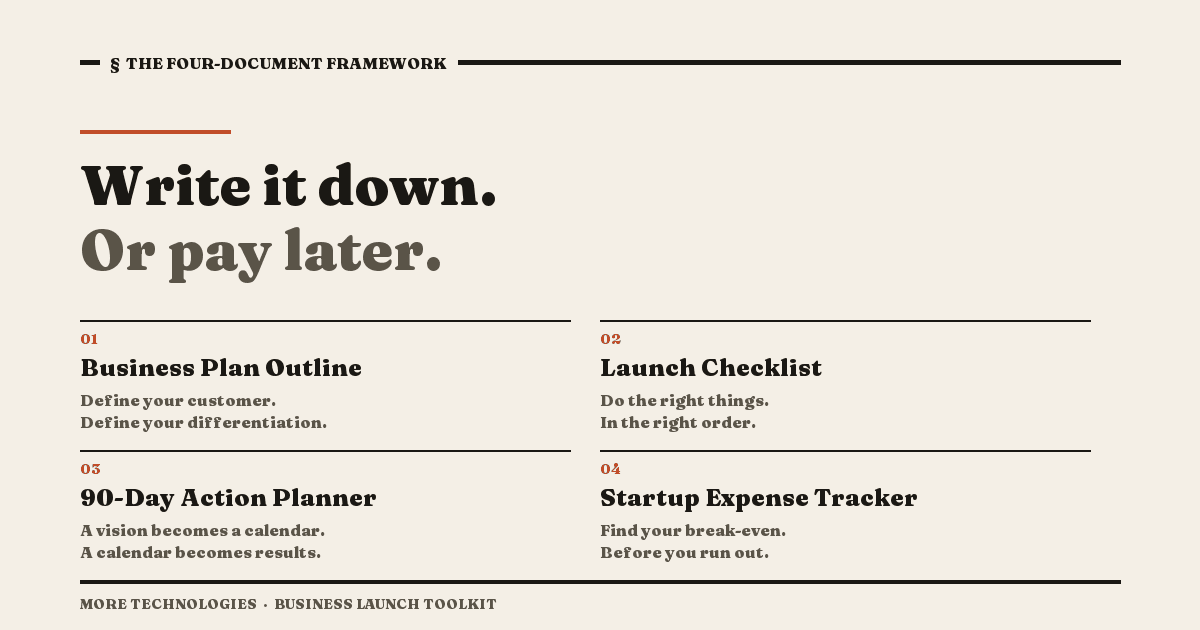
The Business Launch Toolkit: A Four-Document Framework
You do not need a 50-page formal report. You need a map. Learning how to launch a small business starts with these four documents.
The Business Plan Outline
This is an eight-section document. It covers your customer, your offer, your competition, and your primary numbers. When you talk about your business, it sounds great. When you write it, the gaps appear.
Writing your plan forces you to define who is actually going to pay you. You have to explain why they will choose you over the person down the street. If you cannot explain your differentiation in two sentences, you do not have a business yet. You have a hobby.
The act of writing kills bad ideas fast. It is much cheaper to delete a paragraph than it is to close a storefront. This document is your primary tool for clarity and focus.
Consider the freelance graphic designer who decides to "go solo" without a plan. She knows she is good at design, so she spends three weeks picking her own logo and ordering expensive business cards. Because she never wrote down her specific offer or target customer, she spends her first month taking any project that comes her way. She ends up designing a menu for a local diner for $100. The project takes her thirty hours because the owner keeps changing his mind. She realizes too late that she is making $3 an hour. If she had written a plan outline, she would have defined her "ideal client" as a corporate marketing manager with a set budget. She would have seen that a $100 menu was a path to burnout, not a business. The outline forces you to value your time before you give it away to the wrong person.
The Launch Checklist
Starting a business feels like one massive, scary task. It is actually a sequence of small tasks performed in the right order. This checklist breaks the process into seven phases.
You start with validation. You move to legal setup. You build the brand and the offer. Then you market, launch, and follow up. Most people try to do everything at once. They try to pick brand colors before they have validated that anyone wants to buy their product.
The checklist keeps you on track. It prevents the "busy work" that feels like progress but produces no revenue. It ensures you build the foundation before you try to put up the walls.
Think about a baker who wants to open a specialty cookie shop. Without a checklist, she might sign a lease on a retail space because the location looks perfect. Two weeks later, she discovers the electrical wiring cannot handle a commercial-grade oven. Now she is stuck in a three-year contract for a space she cannot use without a $20,000 upgrade she did not budget for. A proper launch checklist has "Technical Requirements and Facility Audit" as a phase that happens before "Sign Lease." Skipping the order of operations creates expensive disasters. The checklist is not about making a list of things to do. It is about making sure you do the right things at the right time. It prevents you from building a roof before you have poured the concrete.
The 90-Day Action Planner
A checklist is a list of tasks. A planner is a calendar. This document maps your actions across your first three months. It turns the checklist into a calendar. Each week has a theme, three actions, and one milestone you have to hit before you roll forward.
Without a timeline, "launching" is always something you will do next month. The 90-day planner creates accountability. It turns your big vision into a schedule. If you are working a 9-to-5 job, your time is your most limited resource. This planner ensures the few hours you have each night are spent on the right things.
A woodworker spends six months building birdhouses in his garage but never actually lists them for sale. He says he is "perfecting the product." In reality, he is hiding from the fear of being rejected by customers. If he had a 90-day action planner, Week 4 would have a milestone labeled "Post First Item for Sale on Etsy." He would have three specific actions: take photos, write descriptions, and set up the shop. The planner makes it impossible to hide in the "product development" phase forever. It forces a rhythm of progress that leads to an actual transaction. You can spend a year being a "maker," but you are not a business owner until you ask for money. The planner sets the deadline for that request. It turns a vague dream into a series of appointments with your own future.
The Startup Expense Tracker
This is the spreadsheet where your dreams meet the math. Most founders do not know their break-even number. They do not know exactly how much money needs to come in before they stop losing money.
The tracker forces you to list every one-time cost and every recurring monthly bill. It includes your revenue projections. It calculates exactly when you will become profitable.
Numbers do not have feelings. They do not care about your passion. They only care about the math. If the spreadsheet shows you will run out of cash in month four, you can change your strategy now. Confronting the math early is the only way to avoid going broke.
A person starts a mobile car detailing business. He buys a used van for $5,000 and spends $1,500 on high-end vacuums and ceramic coatings. He thinks he is doing great because he has $2,000 left in his savings. He calculates that he needs five customers a week to pay his bills. However, he forgot to track his recurring costs. He did not account for the $150 a month for specialized insurance, the $200 a month for gas, or the $100 a month for chemical refills. He also forgot the $800 he owes in self-employment taxes. After three months, he realizes his bank account is at zero even though he is busy. He was profitable on "paper" but losing money in reality because he never tracked the hidden drains on his cash. The expense tracker forces you to see every penny that leaves the business. It turns "I think I am making money" into "I know exactly where my money is."
What This Won't Do for You
This toolkit is a structure. It is not a miracle. These documents will not write the plan for you. They will not pick up the phone and make sales calls. They will not earn your first dollar.
The work is still yours. You still have to show up in the evenings when you are tired. You still have to make the hard decisions. The toolkit simply ensures that when you do the work, you are doing the right work.
Get Started Today
The Business Launch Toolkit is live now. It includes four documents formatted for Google Docs, Google Sheets, Microsoft Word, and Microsoft Excel. It is industry-agnostic. It works for any kind of business in any location.
The first 50 buyers get it for $37. After that, it returns to its $67 sticker price.
This toolkit was built by More Technologies to help you move from "thinking" to "doing." If you want AI to help you fill in your business plan once you have the structure, you can start for free at themoreapp.com.